
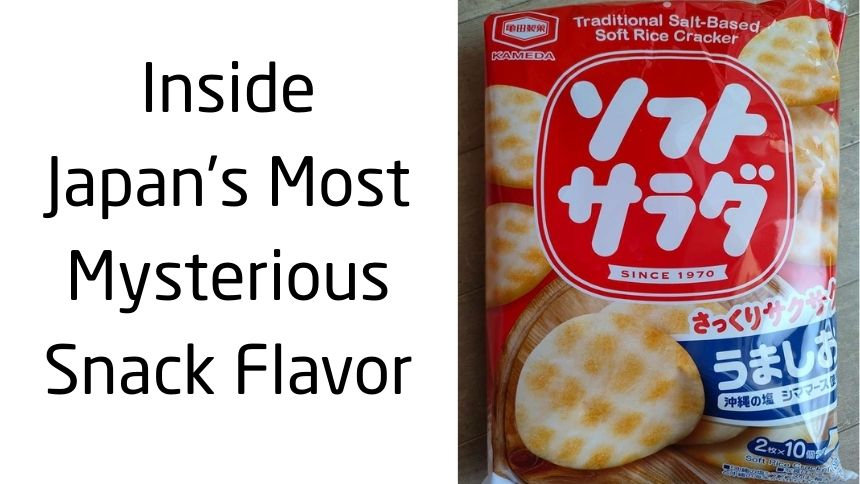
“Salad Flavor” Doesn’t Taste Like Salad
Salad flavor—it’s a classic go-to for snack foods in Japan.
But the flavor itself has nothing to do with a vegetable salad. It doesn’t taste like lettuce or tomatoes. It has neither freshness nor a green, leafy flavor.
Still, in Japan, “salad flavor” snacks are a standard presence on store shelves, right alongside rice crackers and potato chips.
Where Did “Salad Flavor” Come From?

There are a few theories about this strange name. One is that it’s called “salad flavor” because the snacks are coated with salad oil and sprinkled with salt. Another is a folk explanation that the English word “salt” got mispronounced as “salad.”
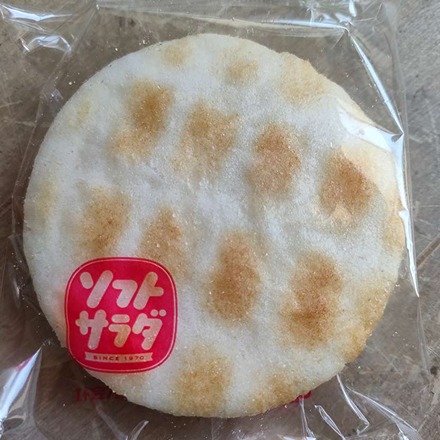
To get straight to the point: the first theory is more credible. In the 1960s, a Japanese rice cracker company launched a new kind of senbei (rice cracker), made by coating baked rice snacks with salad oil and seasoning them with salt. Unlike the then-dominant soy sauce flavor, this light, oil-and-salt-only taste felt new and refreshing. It was marketed with the stylish, Western-sounding name “salad flavor.”
The flavor was a hit. From then on, the combination of “salad oil + salt” became firmly established as “salad flavor.” Even today, within the snack industry, it’s commonly understood that “salad flavor” means seasoned with salad oil and salt.
On the other hand, the theory about “salt” becoming “salad” is amusing from a linguistic standpoint, but there are no official records or developer testimonies to back it up. Based on what we currently know, it’s best regarded as a later folk myth.
So What Exactly Is Salad Oil?

Here’s one important point: what is “salad oil” in the first place?
Salad oil isn’t oil from a specific plant. It’s a general term in Japan for highly refined oils—like canola, soybean, or corn oil—that stay clear at low temperatures and have minimal taste or smell. It was originally named for being usable “as is” on raw vegetables—in other words, oil suitable for salads.
That’s why salad oil has no strong personality. Its lack of noticeable taste or aroma is actually what makes it valuable.
Seen this way, the fact that salad flavor is “a salty taste that’s hard to describe” is quite fitting. That light taste—coated in salad oil and dusted with salt—reflects the very character of salad oil itself.
How Japanese People Relate to Salad Flavor

My relationship with salad flavor is like one with a childhood friend. We may go long periods without meeting, but when we do, we pick up right where we left off. It’s the kind of presence that casually shows up when I visit my hometown.
I suspect many Japanese people feel the same way about salad flavor. I’ve never heard anyone say, “I love salad flavor!”—and I don’t feel that way myself. It’s not a favorite. And yet, somehow, I find myself reaching for it. After one bite, I want another. And another. It’s endlessly snackable, with a mysterious sense of comfort.
Why Call It “Salad Flavor” Instead of Just “Salt”?

Looking back, calling it “salad flavor” instead of just “salt” was probably the right decision. If I had been in charge of product development, I doubt I would have gone with that name—because it really doesn’t taste like salad at all.
But if it had been named “salad oil flavor,” it likely wouldn’t have caught on the same way. In Japan, when you hear “salad flavor,” everyone immediately knows that taste. It has become a common understanding that requires no explanation.
It’s Not That Japanese People Don’t Know What Salad Is

To be clear, it’s not that Japanese people are unaware of what salad is. Everyone knows that salad is a dish made from vegetables. These days, it’s common to see not just leafy green salads with dressing, but also potato salads, pasta salads, and salads topped with tuna, chicken, or boiled eggs. A quick look at the salad section in any convenience store proves that.
Salad flavor isn’t the taste of salad. It’s a concept that grew uniquely within the Japanese language—a flavor born from imagery, not ingredients.
Tips for Travelers: How to Buy Salad Flavor Snacks

If you ever get the chance to visit Japan, I highly recommend trying something labeled with “salad flavor.” You’ll find it almost without fail at convenience stores and supermarkets. Just be aware—it won’t say salad flavor in English. The label will say “サラダ” in Japanese. The quickest way is to remember that word as it is. Even saying “salad” in English likely won’t help the store clerk understand—make sure you pronounce it clearly as “SA-RA-DA.”
Some images used in this article were automatically generated by AI and contain no specific meaning or intentional references whatsoever.
Comment